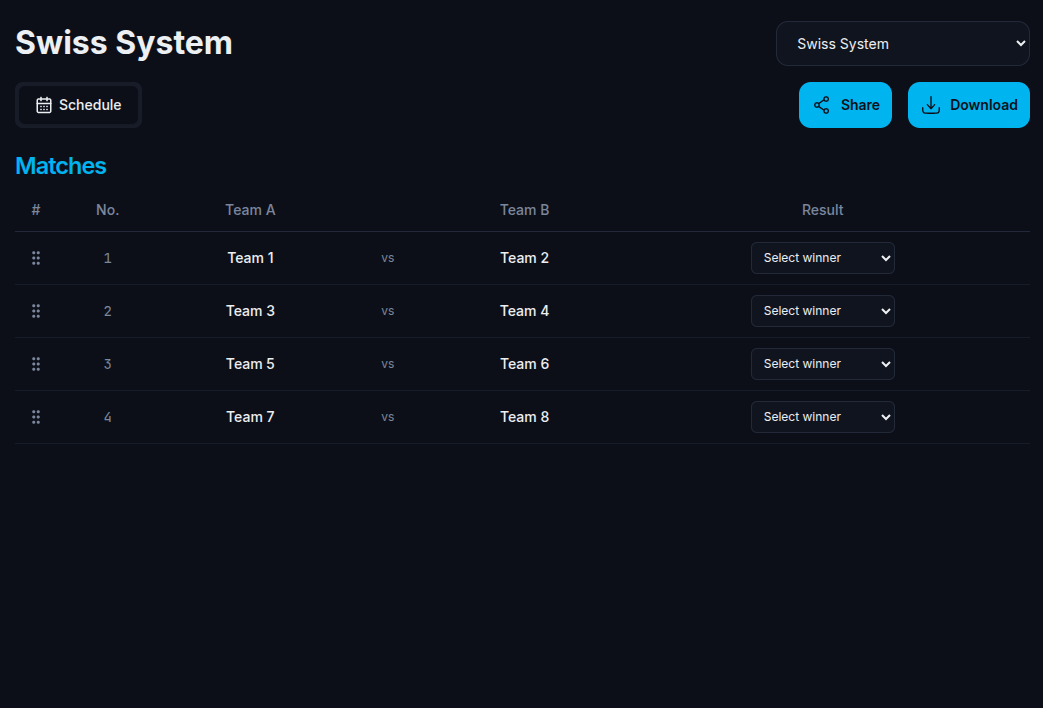
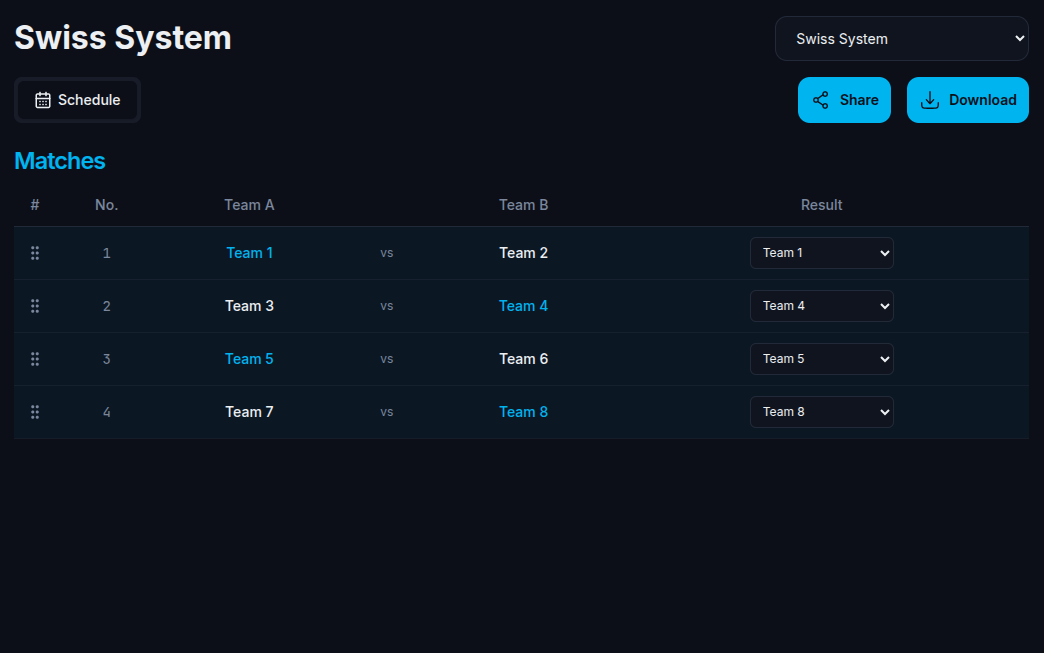
What is a Swiss System tournament?
A Swiss System tournament is a competition format in which participants play a set number of rounds and are paired based
on their results as the tournament progresses. Participants are not eliminated after a single loss.
How does a Swiss System tournament work?
Participants play an opening round, and results contribute to their standings. For subsequent rounds, participants are
typically paired with others who have similar scores, following the competition's pairing rules.
How many rounds should a Swiss tournament have?
The number depends on the number of participants and the level of ranking accuracy required. For example, a 16-player
tournament might use four or five rounds, while a 32-player tournament might use five or six. The organizer should
choose the number of rounds and tie-break rules before the event begins.
Are participants eliminated after losing a Swiss System match?
No. A loss does not automatically eliminate a participant. They normally continue playing in the remaining scheduled
rounds, subject to the competition rules.
How are pairings decided in a Swiss tournament?
Pairings typically consider participants' current scores or records. Organizers also commonly try to avoid repeat
opponents and follow rules for colors, sides, or other competition-specific constraints where applicable.
How is the winner decided in a Swiss tournament?
The winner is generally the participant with the highest score after all scheduled rounds. If participants finish tied,
published tie-break rules—such as opponents' performance or other competition-specific criteria—may determine the
ranking.
What happens when there is an odd number of participants?
A round with an odd number of eligible participants typically requires one participant to receive a bye or a designated
equivalent under the tournament rules. Bye eligibility and scoring depend on the competition's regulations.
What is the difference between Swiss System and Round Robin?
In Round Robin, every participant plays every other participant. In Swiss System, participants play only a limited
number of rounds and are paired according to their results. Swiss tournaments are therefore useful when a full round
robin would require too many matches.
Can a Swiss System tournament have a knockout final?
Yes. Some competitions use Swiss rounds to rank participants and then send the highest-ranked participants into a
separate knockout playoff. Other Swiss tournaments finish after the scheduled rounds, with the final standings deciding
the winner.
Can I create a Swiss System tournament with BracketBuddy?
Yes. BracketBuddy supports a Swiss System tournament format. You can use the tournament setup and the scheduling, results,
standings, sharing, and PDF features available in the app.